

Push Rod Suspension
Push-Rod Suspension
What matters in pursuing suspension performance is to receive the forces coming from the road properly and to control the movement of the chassis precisely. And the design philosophy of how to achieve that function through a rational structure.
The push-rod suspension adopted by Vyrus uses an original linkage to pursue both optimised suspension action and a lighter structure.
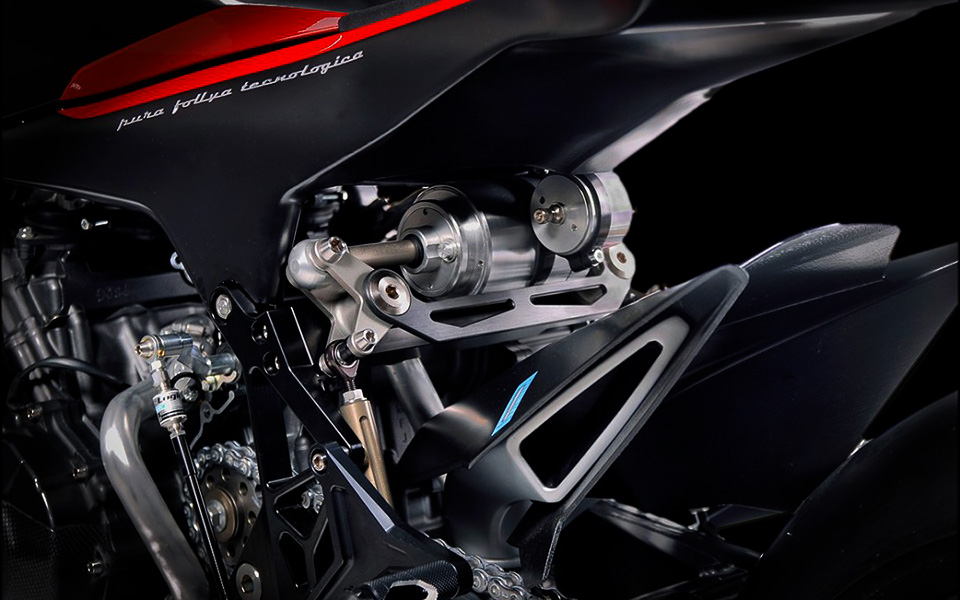
An original double push-rocker mechanism
What defines this suspension is its own mechanism, made up of two connecting rods linked to the swingarm and a rocker arm for each of them.
The movement of the swingarm is transmitted through the two rods to the rocker arms, which operate the suspension.
With the rods on the left and right transmitting force symmetrically, uneven loading is suppressed and a stable balance of action is ensured. In addition, the geometric relationship of the linkage sets the progressive characteristics of the suspension.
Progressive characteristics describe how the ratio between wheel movement and shock absorber displacement changes with the amount of suspension stroke.
This is an important factor in designing how the reaction force changes through the stroke, and it is the basis for combining good road-following with a stable chassis attitude.
Lightness through a rational structure
In a suspension mechanism, it is important not only to transmit loads properly but also to keep unnecessary stress on the components to a minimum.
The Vyrus double push-rocker mechanism transmits force symmetrically to the left and right arms, aiming to suppress twisting in the moving parts.
Designing the load path rationally also helps keep the structure compact while ensuring the strength and rigidity each part needs.
Through this design, the components, swingarm included, are made smaller and lighter, leading to an efficient design of the chassis as a whole.
Freedom of set-up for every riding condition
Another feature of the double push-rocker mechanism is its flexibility in adjusting the suspension characteristics.
The rocker arms are designed to be changed in a short time, and by changing the linkage setting, the progressive characteristics can be adjusted.
By changing the linkage ratio that determines how the suspension moves, the reaction force through the stroke can be altered, allowing a set-up suited to riding conditions and the rider's needs.
Response to inputs from the road, changes in chassis attitude, the behaviour of the suspension. It is a mechanism for finding the right setting for each purpose while weighing how these relate to one another.
An original structure derived from function
Load transmission through two connecting rods and rocker arms, balanced action from a symmetrical structure, and a design that allows the progressive characteristics to be adjusted.
By combining each of these functions rationally, Vyrus engineering pursues both suspension performance and a lighter structure.
Not the adoption of a complex mechanism for its own sake, but finding the best structure to achieve the performance required.
That design philosophy lives on in the original suspension mechanism that is unique to Vyrus.