

Trail and Vyrus
Trail and Vyrus
Trail is one of the key elements of chassis design that governs a motorcycle's handling and stability. Response to the rider's input, stability in a straight line, steering behaviour in corners. These are closely tied to the chassis geometry, and setting the trail that underlies it calls for careful study with the character of the whole machine in view.
With its original hub-center steering, Vyrus has achieved a design free from conventional chassis structures, and has pursued the ideal relationship between handling and stability.
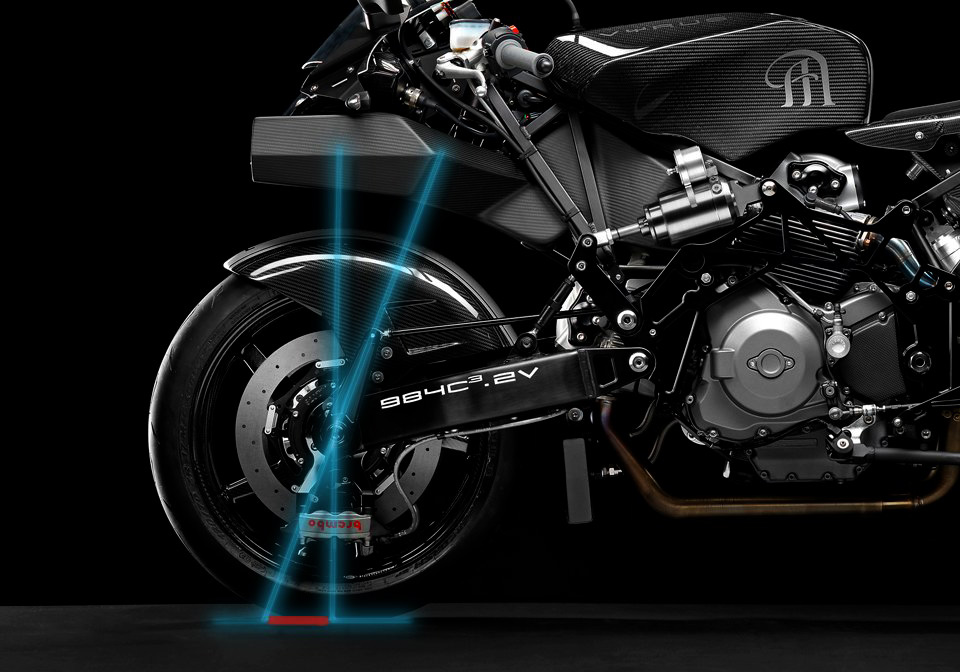
What is trail?
Trail is the horizontal distance between the point where the steering axis, extended to the ground, meets it and the contact point of the front tyre. Usually expressed in millimetres, it is an important dimension related to the self-aligning action that turns the front wheel back towards the direction of travel. While riding, various forces act on the front wheel from the road surface. Because the contact point of the front tyre lies behind the point where the steering axis meets the ground, lateral forces on the tyre create a moment about the steering axis that contributes to stability in the direction of travel. All else being equal, more trail tends to give greater straight-line stability, and less trail tends to give lighter steering response. Yet trail alone does not determine how a motorcycle actually handles. Many factors interact in complex ways: tyre characteristics, vehicle weight, centre of gravity, wheelbase, the inclination of the steering axis and more.
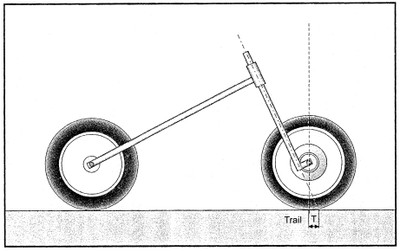
Stability and handling
More trail generally works towards greater straight-line stability, but it also tends to increase the effort needed to steer and to make the response to changes of direction more gentle. Less trail, on the other hand, makes light handling easier to achieve, but depending on conditions it can reduce stability in a straight line and the margin against disturbances. What matters is not to favour either stability or handling, but to find the right balance for the purpose and design philosophy of the machine.
A sports motorcycle that seeks sharp response and a cruiser that values gentle handling call for different ideal geometries. Trail is not an independent measure of performance, but a dimension closely linked to the design of the entire chassis.
The geometry that determines trail
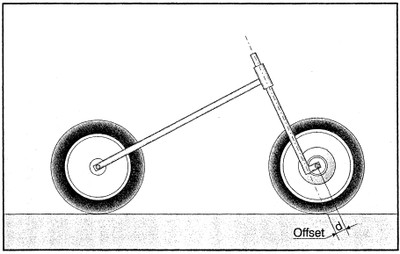
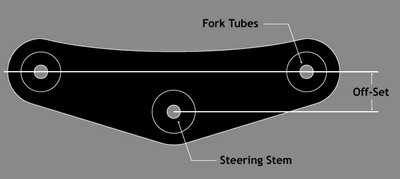
On a typical motorcycle with a telescopic fork, the main factors that determine trail are the rake angle and the offset. The rake angle is the inclination of the steering axis, and the offset is the dimension that describes the position of the front axle relative to the steering axis. Combined with conditions such as the radius of the front wheel, these determine the amount of trail.
In general, a larger rake angle increases trail, and a larger offset reduces it. With a conventional telescopic fork, changing the offset may require a steering stem or triple clamps of different dimensions. And because the rake angle is closely tied to the frame structure, changing it substantially is not easy. Vyrus approaches these structural constraints from a different design philosophy.
The choice of hub-center steering
The hub-center steering adopted by Vyrus has a structure fundamentally different from that of a typical telescopic fork. By supporting the front wheel and steering it through separate mechanisms, it makes possible a chassis geometry unlike that of a conventional front fork. One of its features is the ability to adjust the inclination of the steering axis and the amount of trail.
In the mechanism described in the current technical explanation, the effective length of the anti-dive rod is changed by how far the spherical joint connected to it is screwed in, adjusting the steering geometry. Without major changes to the basic chassis structure, the geometry can be set to suit riding conditions and the rider's needs. Beyond the adjustment itself, the greater freedom it gives the design is another important significance of this structure. It is original engineering for pursuing the relationship between stability and response more flexibly.
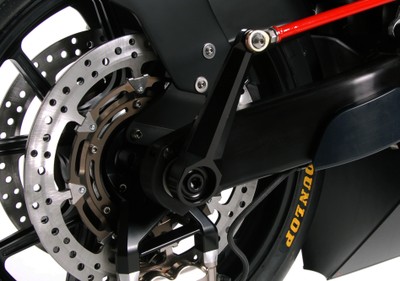
Handling shaped by an original structure
What characterises Vyrus chassis design is the combination of hub-center steering and its own chassis geometry. As one example, a setting of 0 mm offset, an 18° steering axis angle, 80 mm of trail and a 1,350 mm wheelbase is given. Yet these figures alone cannot define how a machine handles. The structure of the steering mechanism, the centre of gravity, the weight distribution between the wheels, the behaviour of the suspension. It is the interaction of each of these elements that forms the dynamics of a motorcycle.
What Vyrus pursues is not the adoption of an innovative mechanism for its own sake, but the harmony of handling and stability that its structure makes possible. A deep understanding of motorcycle dynamics, and the ideal ride drawn from mechanical rationality.
Original hub-center steering embodies the design philosophy of Vyrus, which continues to explore the possibilities of technology, free from convention.